what chemical to wash out keurig for storage
If you lot're here because of Keurig plastic taste, you're in the right place! If your Keurig has stopped brewing, I have some suggestions on how to ready that.
So anyway, I wrote a whole matter about how to remove plastic gustation from coffee makers in general (read information technology hither), and about of that stuff actually does employ to Keurigs also. Vinegar is probably the nearly mutual solution to plastic taste woes, simply it doesn't work for everyone.
I've done some digging, and there are a couple of solutions that might succeed where vinegar fails. Still, we're going to commencement with the near basic fixes first (including vinegar), and then we'll wait at a couple of other options that your googling may not have revealed yet.
But get-go, a disclaimer: If y'all do anything suggested on this page and your Keurig all of a sudden breaks, that's on you! Non me. I find this scenario unlikely, but it'due south your java maker. You brand the decisions on what you're willing to do to it. Hence, I now pre-declare "don't await at me" in the event of any Keurig breakage.
Solution #1: Run a couple of reservoir'south worth of hot water through the machine

Here's what you lot exercise:
- First, wash your water reservoir with warm, soapy h2o. Wash it thoroughly, inside and out, and rinse it clean.
- Fill the reservoir with h2o upwards to the "fill" line.
- Set your Keurig to the highest temperature setting if your coffee maker has that feature.
- Without using a K-cup, run enough brew cycles to empty at least one or two total reservoirs of clean water through the automobile.
I know this "prepare" might seem like information technology'south inappreciably worth trying, but some folks out at that place on the Interwebs have actually reported success with this technique.
I think it would exist reasonable to theorize that simply rinsing the machine out could remove any residue lurking within the machine from the manufacturing process. Also, washing the reservoir of any balance or chemicals certainly tin't hurt.
Aye, you lot've already run water through your Keurig in the process of making coffee. Merely if your first loving cup tasted like plastic, how many more did you brew? Flush that thing out and see what happens.
Solution #two: Run vinegar through your Keurig
This is easily the virtually common method of attempting to remove the plastic sense of taste from a Keurig. As of today, if y'all google "Keurig plastic gustatory modality," Google presents y'all with a video where some guy basically but says, "put vinegar in your Keurig." I'll include that video at the end of this section just for fun.
The vinegar rinse will work for some, but not for everyone. Why? I'm non sure, but my personal theory is that some people are more susceptible to tasting certain chemicals than others. If your tastebuds are hyper-sensitive to plastic taste, you may need to exercise more than than just run vinegar through your Keurig.
Mr. Millennial in the video downward below also mentions that plastic gustation occurs in newer Keurigs. Well … yep! Doy. The reason for that is "outgassing" which is when the plastic parts of the coffee maker release gases that formed in the plastic during manufacturing.
According to the outgassing theory (which not everyone is onboard with), a Keurig that rolls off the assembly line today will produce a stronger plastic gustatory modality than 1 that's been sitting on a shelf for a while. Outgassing occurs over time, you run across. And those gases get into the water that becomes your coffee.
Anyway, when it comes to vinegar, y'all have a conclusion to make. How much vinegar exercise you want to utilize?
Depending on your level of patience and how much vinegar is in your kitchen right at present, you may want to go for a run of straight, undiluted distilled white vinegar. This is the most "aggressive" arroyo, as far as vinegar goes, and it will take more water to flush the vinegar sense of taste out.

If you lot adopt to exist more than cautious, start with a fifty/50 dilution of distilled white vinegar and water. If you observe that your Keurig is producing less-plasticky coffee, but still plasticky nevertheless, endeavour again with a stronger dilution or no dilution at all.
Here's what you exercise:
- Starting time, wash your h2o reservoir with warm, soapy h2o. Wash it thoroughly, within and out, and rinse it make clean. This is something you should be doing regularly, anyhow.
- Remove the charcoal water filter.
- Fill up the reservoir to the "fill up" line with your preferred mix of distilled white vinegar (Amazon link) and water, or merely directly vinegar if you're going balls out.
- Set up your Keurig to the highest temperature setting if your java maker has that characteristic.
- Subsequently running enough mash cycles to empty the reservoir (no M-cup, of class), repeat with h2o only. Run h2o-only mash cycles until you can no longer taste the vinegar.
Did that fix it? No? Keep reading.
Solution #3: Buy a reusable stainless steel K-cup
If you lot dearest your plastic K-cups and are heavily invested in ane of those K-cup organizers, deplorable non sorry. Information technology'south true that 1000-cups are now recyclable, and that's bang-up, but using less plastic is generally a good do if you lot can manage it.
Plus, bonus! Your reusable K-cup volition save you lot coin in the long run because you lot'll exist filling it with coffee that y'all buy past the pound. I suppose you could still rip open a K-cup and pour it into the reusable stainless steel Chiliad-loving cup, just that just seems silly.
The reason the stainless steel K-cup might kill the plastic sense of taste is that you're taking a very important piece of plastic out of the equation: the plastic M-loving cup!
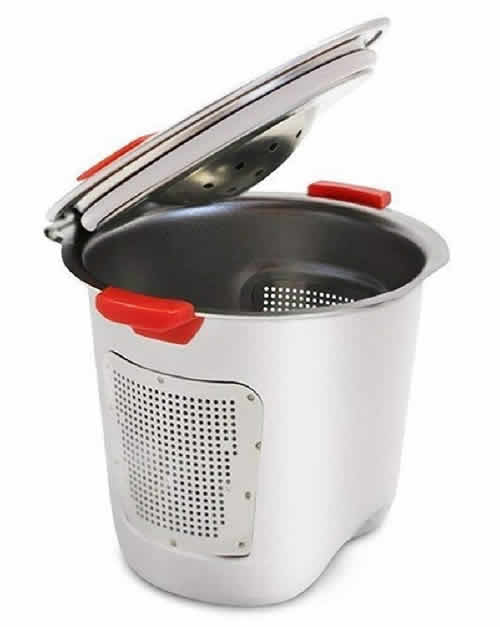
I accept written volumes nigh the evils of plastic in the coffee-making process. Plastic leaches into water. Where that leaching occurs is still upwardly for debate, but if the h2o rinse didn't work, and if the vinegar rinse didn't work, removing the plastic Grand-cup would seem to be the next logical step.
A quick search for "plastic taste" in the Amazon reviews for the stainless steel K-cup pictured above (Amazon link) reveals a whole agglomeration of people who say that it has improved the taste of their Keurig java.
Admittedly, only one person has explicitly stated that their plastic taste problem went away thanks to this stainless steel K-loving cup, but that's at to the lowest degree encouraging if nothing else.
To quote that 1 Amazon reviewer ("American Pie"):
Plastic k-cuptaste is gone!
Give it a try. You've really got nothing to lose.
Solution #iv: Run nutrient-course activated charcoal through your Keurig
And so far, I accept seen this solution suggested past precisely one person on the internet, and information technology was in a YouTube comment from a lovely gem named Jennifer Carducci. Hither's what she had to say:
About 3/four tsp food grade activated charcoal works perfectly. Just added it to warm water, put information technology in the reservoir and the smell was gone on the get-go pass through. I ran it through a few more times simply to be sure.
Notice that she said smell, non gustatory modality. Simply she wrote that comment in the comment section of the Vinegar + Keurig video to a higher place. You know, the 1 where Mr. Millennial is inexplicably floating in abstract white space while he discusses plastic taste in Keurigs. I estimate we just have to hope for the all-time here.
At this signal, you lot may be wondering what "activated charcoal" actually is and why it might work.
According to WebMD (link), activated charcoal is made by heating common charcoal in the presence of a gas that causes the charcoal to form pores, a.k.a. little holes. So those pores serve to somehow "trap" chemicals and forestall them from being absorbed by the trunk or, in this case, your Keurig.
Ok, this sounds pretty plausible. After all, plenty of coffee makers (notably, those made past Mr. Coffee, Cuisinart, and Keurig) already accept built-in charcoal filters that are meant to ameliorate the sense of taste of your coffee. But if your Keurig already has a charcoal filter, why run a diluted mix of activated charcoal through it?

I suppose we can conjecture that the charcoal filter in your Keurig is designed to filter the h2o from your reservoir only. That'due south where the filter lives, so information technology'due south not going to work its magic on the inside of the machine.
Perhaps running activated charcoal through your Keurig is an effective way of removing chemical compounds that live in your Keurig's prophylactic tubing?
All I tin can tell you is that it worked for Jennifer Carducci. I don't know Jennifer, but I don't meet why she (or anyone) would make up such a wild tale if information technology weren't at least partially truthful.
And so, based on Ms. Carducci's sage advice, hither's what I assume you lot should practice:
- First, wash your water reservoir with warm, soapy water. Wash information technology thoroughly, inside and out, and rinse information technology clean. This is something you should be doing regularly, anyhow.
- Remove the charcoal water filter. Filtering the charcoal out of your water with a charcoal filter sounds pretty counterproductive.
- Make full the reservoir to the "fill" line with warm water.
- Add 3/4 tsp. of activated charcoal (Amazon link) to the water and mix it well.
- Fix your Keurig to the LOWEST temperature setting if you lot have this characteristic. Google tells me that college water temperature tin decrease the effectiveness ("adsorption rate") of activated charcoal.
- Run enough brew cycles (no K-cup) to empty the reservoir.
- Run clean water through the machine and come across how information technology tastes. Echo the charcoal water rinse if necessary.
I guess information technology'due south also worth noting that you could increase the dilution of activated charcoal if your Keurig plastic taste persists. I don't see why this would have any negative effects on your Keurig's power to office, but call back my disclaimer from above!
Conclusion
Plastic sense of taste, whether it's in your Keurig or any other coffee maker, seems similar a problem that's going to plague any coffee maker that's manufactured with plastic parts.
We can contend the causes and solutions until nosotros're blue in the face, merely what'due south important is that we detect solutions and SHARE them! Of course, what works for you may non work for your neighbor (that's the fun of the plastic taste mystery), simply sharing truly is caring.
And who knows, perhaps the story of your success will help solve someone else's problem, too.
Accept any of the Keurig plastic gustation fixes above worked for you? Or possibly you did something different that solved your plastic gustation trouble? Please be a pal and share your story in the comment box below!
I moderate comments considering of evil spammers, simply all not-spammy comments volition be approved as soon every bit I see them.
(Visited 19,572 times, 1 visits today)
Source: https://buydontbuy.net/2019/02/12/how-to-remove-plastic-taste-from-keurig/

Post a Comment for "what chemical to wash out keurig for storage"