5 Draw a Vinn Diagram to Illustrate This Conditional
Probability Topics
xix Venn Diagrams
Venn Diagrams
A Venn diagram is a picture that represents the outcomes of an experiment. It more often than not consists of a box that represents the sample infinite S together with circles or ovals. The circles or ovals represent events. Venn diagrams also help the states to convert common English words into mathematical terms that help add precision.
Venn diagrams are named for their inventor, John Venn, a mathematics professor at Cambridge and an Anglican minister. His main work was conducted during the late 1870's and gave rise to a whole co-operative of mathematics and a new way to approach issues of logic. We will develop the probability rules just covered using this powerful manner to demonstrate the probability postulates including the Addition Rule, Multiplication Rule, Complement Dominion, Independence, and Provisional Probability.
Suppose an experiment has the outcomes i, 2, iii, … , 12 where each upshot has an equal chance of occurring. Let event A = {1, 2, 3, four, 5, 6} and event B = {6, seven, eight, nine}. Then A intersect B =  and A union B =
  . The Venn diagram is as follows:

(Effigy) shows the most basic human relationship amid these numbers. First, the numbers are in groups called sets; set up A and set B. Some number are in both sets; we say in set A  in gear up B. The English language word "and" means inclusive, meaning having the characteristics of both A and B, or in this case, existence a office of both A and B. This condition is called the INTERSECTION of the two sets. All members that are part of both sets plant the intersection of the two sets. The intersection is written equally
  where is the mathematical symbol for intersection. The statement is read every bit "A intersect B." You can remember this by thinking of the intersection of two streets.
In that location are also those numbers that course a group that, for membership, the number must exist in either one or the other group. The number does not accept to exist in BOTH groups, but instead but in either one of the ii. These numbers are called the UNION of the two sets and in this instance they are the numbers 1-five (from A exclusively), seven-9 (from fix B exclusively) and likewise 6, which is in both sets A and B. The symbol for the Matrimony is  , thus
  numbers 1-9, simply excludes number 10, xi, and 12. The values 10, 11, and 12 are part of the universe, but are not in either of the two sets.
Translating the English word "AND" into the mathematical logic symbol , intersection, and the word "OR" into the mathematical symbol , marriage, provides a very precise manner to discuss the bug of probability and logic. The general terminology for the iii areas of the Venn diagram in (Figure) is shown in (Figure).
Attempt It
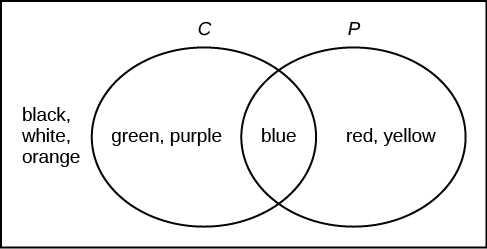
Suppose an experiment has outcomes black, white, red, orange, yellow, dark-green, blueish, and regal, where each outcome has an equal chance of occurring. Allow consequence C = {green, blueish, majestic} and event P = {red, yellowish, blueish}. Then  and
and  . Describe a Venn diagram representing this situation.
Flip two fair coins. Let A = tails on the first money. Let B = tails on the second coin. Then A = {TT, Thursday} and B = {TT, HT}. Therefore,  .
.  .
.
The sample space when you lot flip two fair coins is X = {HH, HT, Thursday, TT}. The outcome HH is in NEITHER A NOR B. The Venn diagram is equally follows:

Try It
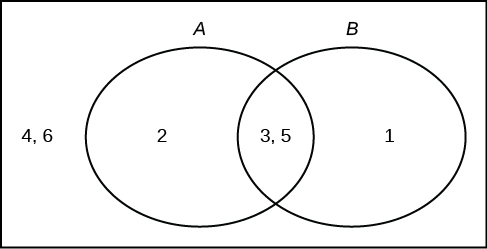
Roll a fair, half-dozen-sided die. Let A = a prime number of dots is rolled. Let B = an odd number of dots is rolled. And so A = {two, 3, v} and B = {1, iii, 5}. Therefore,  .
.  . The sample space for rolling a fair die is Southward = {1, ii, three, iv, 5, vi}. Draw a Venn diagram representing this situation.
A person with blazon O blood and a negative Rh factor (Rh-) can donate blood to whatsoever person with any blood type. Four pct of African Americans have blazon O blood and a negative RH factor, 5−10% of African Americans have the Rh- gene, and 51% have type O claret.

The "O" circumvolve represents the African Americans with type O claret. The "Rh-" oval represents the African Americans with the Rh- gene.
We will accept the average of 5% and 10% and utilise 7.v% as the percent of African Americans who accept the Rh- cistron. Let O = African American with Type O blood and R = African American with Rh- factor.
- P(O) = ___________
- P(R) = ___________
-
 ___________
 -
 ____________
 - In the Venn Diagram, describe the overlapping surface area using a complete sentence.
- In the Venn Diagram, describe the expanse in the rectangle but outside both the circle and the oval using a complete judgement.
a. 0.51; b. 0.075; c. 0.04; d. 0.545; eastward. The expanse represents the African Americans that have type O blood and the Rh- factor. f. The expanse represents the African Americans that have neither type O claret nor the Rh- factor.
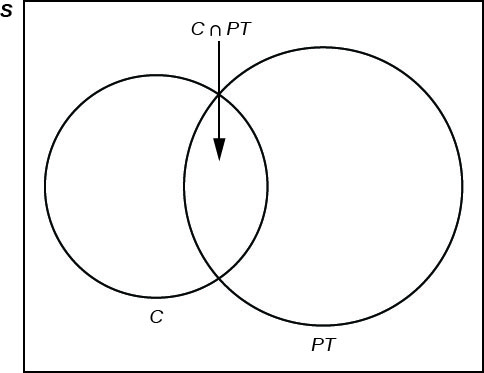
Twoscore percent of the students at a local college belong to a club and l% work part fourth dimension. Five percent of the students piece of work part time and belong to a guild. Depict a Venn diagram showing the relationships. Let C = student belongs to a club and PT = pupil works part time.
If a student is selected at random, find
In order to solve (Figure) nosotros had to describe upon the concept of conditional probability from the previous department. There we used tree diagrams to track the changes in the probabilities, considering the sample infinite changed as we drew without replacement. In short, provisional probability is the chance that something will happen given that some other event has already happened. Put another way, the probability that something volition happen conditioned upon the situation that something else is also true. In (Figure) the probability P(C  PT) is the conditional probability that the randomly drawn student is a member of the club, conditioned upon the fact that the student as well is working part time. This allows us to encounter the human relationship between Venn diagrams and the probability postulates.
Try It
Fifty percent of the workers at a manufacturing plant piece of work a second job, 25% have a spouse who also works, 5% work a 2d job and have a spouse who also works. Draw a Venn diagram showing the relationships. Let W = works a second task and S = spouse also works.

Try Information technology
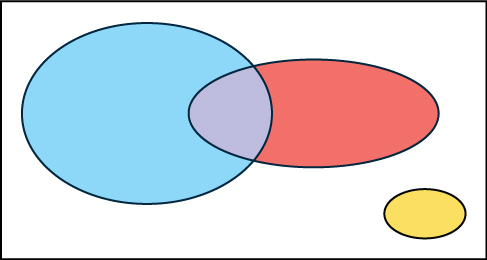
In a bookstore, the probability that the client buys a novel is 0.half-dozen, and the probability that the customer buys a non-fiction book is 0.4. Suppose that the probability that the customer buys both is 0.2.
- Describe a Venn diagram representing the situation.
- Find the probability that the customer buys either a novel or a non-fiction book.
- In the Venn diagram, depict the overlapping surface area using a complete sentence.
- Suppose that some customers buy but meaty disks. Describe an oval in your Venn diagram representing this outcome.
a. and d. In the following Venn diagram below, the blue oval represent customers ownership a novel, the red oval represents customer buying non-fiction, and the yellow oval customer who buy meaty disks.
b. P(novel or non-fiction) = P(Bluish Crimson) = P(Blue) + P(Red) – P(Blue Ruby-red) = 0.half dozen + 0.iv – 0.2 = 0.viii.
c. The overlapping area of the bluish oval and cerise oval represents the customers buying both a novel and a nonfiction volume.
A set of xx German language Shepherd dogs is observed. 12 are male, 8 are female, ten have some brown coloring, and 5 accept some white sections of fur. Answer the following using Venn Diagrams.
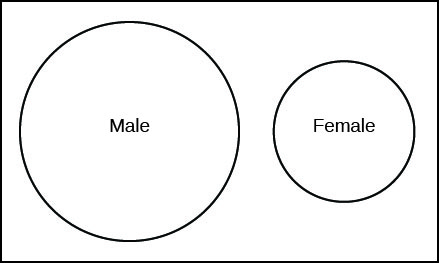
Draw a Venn diagram merely showing the sets of male and female dogs.
The Venn diagram below demonstrates the state of affairs of mutually sectional events where the outcomes are independent events. If a dog cannot be both male person and female, then there is no intersection. Being male precludes beingness female person and being female precludes existence male: in this case, the characteristic gender is therefore mutually exclusive. A Venn diagram shows this equally ii sets with no intersection. The intersection is said to be the null prepare using the mathematical symbol ∅.
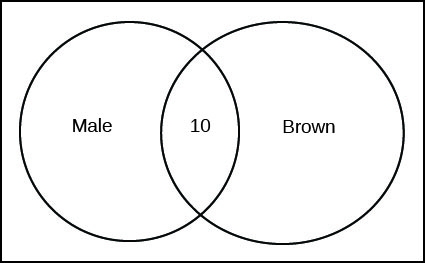
Draw a second Venn diagram illustrating that x of the male dogs have brownish coloring.
The Venn diagram below shows the overlap betwixt male and chocolate-brown where the number 10 is placed in it. This represents  : both male and brown. This is the intersection of these two characteristics. To get the union of Male person and Brown, and so it is simply the two circled areas minus the overlap. In proper terms,
  will give us the number of dogs in the union of these two sets. If we did not subtract the intersection, nosotros would have double counted some of the dogs.
The Addition Dominion of Probability
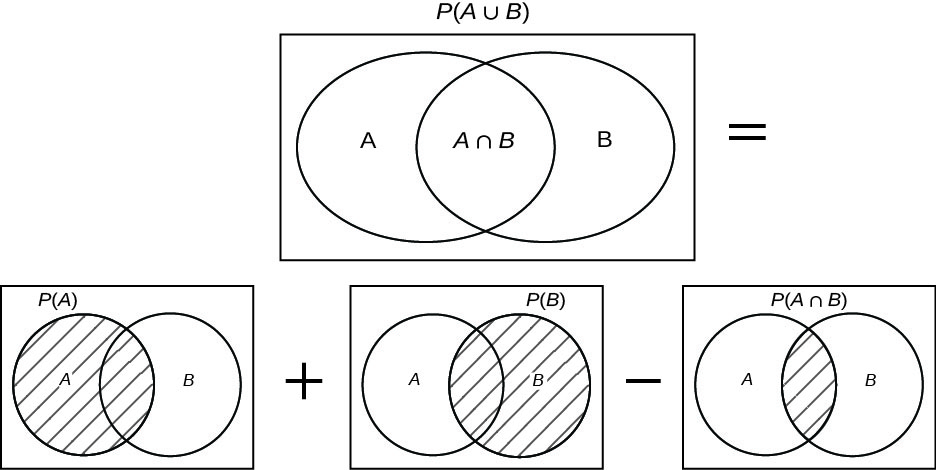
We met the addition rule earlier but without the help of Venn diagrams. Venn diagrams help visualize the counting procedure that is inherent in the adding of probability. To restate the Addition Rule of Probability:

Call back that probability is simply the proportion of the objects nosotros are interested in relative to the total number of objects. This is why we tin see the usefulness of the Venn diagrams. (Figure) shows how we tin apply Venn diagrams to count the number of dogs in the marriage of brown and male person past reminding us to subtract the intersection of brown and male person. We tin can see the effect of this directly on probabilities in the add-on rule.
Allow'due south sample l students who are in a statistics class. 20 are freshmen and 30 are sophomores. fifteen students get a "B" in the course, and 5 students both get a "B" and are freshmen.
Notice the probability of selecting a student who either earns a "B" OR is a freshmen. We are translating the word OR to the mathematical symbol for the addition dominion, which is the union of the two sets.
We know that there are l students in our sample, so we know the denominator of our fraction to give united states probability. We demand but to detect the number of students that run into the characteristics we are interested in, i.e. any freshman and any educatee who earned a class of "B." With the Addition Dominion of probability, we can skip directly to probabilities.
Let "A" = the number of freshmen, and permit "B" = the grade of "B." Below we can see the process for using Venn diagrams to solve this.
The  ,
,  , and
, and  .
.
Therefore,  .
.
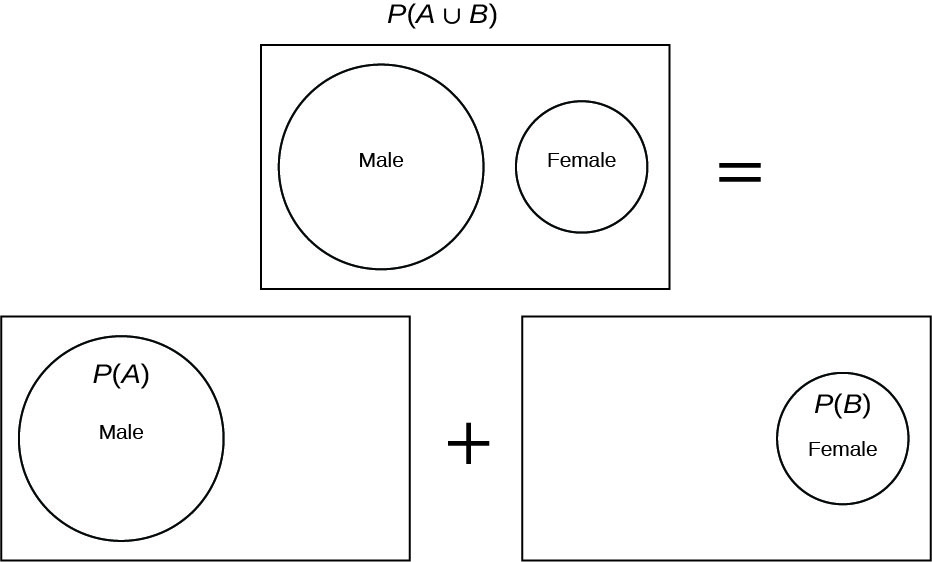
If two events are mutually exclusive, then, similar the example where we diagram the male and female dogs, the addition rule is simplified to but  . This is true considering, every bit we saw before, the union of mutually exclusive events is the zilch set, ∅. The diagrams below demonstrate this.
The Multiplication Dominion of Probability
Restating the Multiplication Dominion of Probability using the note of Venn diagrams, we take:

The multiplication rule tin can be modified with a bit of algebra into the following provisional rule. Then Venn diagrams can then be used to demonstrate the process.
The provisional rule: 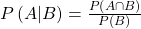
Using the same facts from (Effigy) to a higher place, observe the probability that someone volition earn a "B" if they are a "freshman."

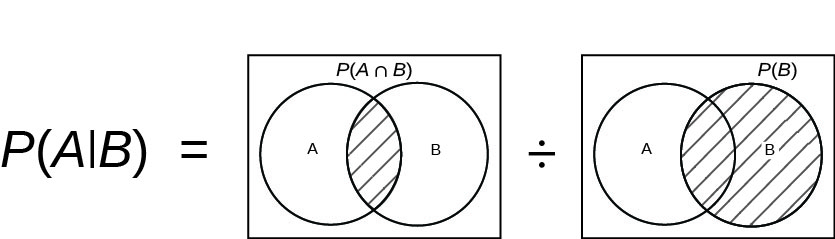
The multiplication dominion must also be contradistinct if the ii events are contained. Independent events are defined as a situation where the conditional probability is just the probability of the event of involvement. Formally, independence of events is divers as  or
or  . When flipping coins, the outcome of the 2d flip is independent of the outcome of the first flip; coins exercise not have retention. The Multiplication Rule of Probability for independent events thus becomes:

1 like shooting fish in a barrel way to call up this is to consider what we mean by the word "and." We see that the Multiplication Rule has translated the discussion "and" to the Venn notation for intersection. Therefore, the outcome must meet the two conditions of freshmen and course of "B" in the higher up example. It is harder, less likely, to meet two conditions than just ane or some other i. We can effort to see the logic of the Multiplication Rule of probability due to the fact that fractions multiplied times each other become smaller.
The development of the Rules of Probability with the employ of Venn diagrams tin can be shown to help every bit we wish to summate probabilities from information bundled in a contingency table.
(Effigy) is from a sample of 200 people who were asked how much education they completed. The columns represent the highest education they completed, and the rows separate the individuals by male and female.
| Less than loftier school grad | High schoolhouse grad | Some college | College grad | Full | |
| Male | v | 15 | 40 | lx | 120 |
| Female | 8 | 12 | 30 | 30 | 80 |
| Total | 13 | 27 | 70 | ninety | 200 |
At present, we tin utilize this table to answer probability questions. The following examples are designed to aid understand the format higher up while connecting the cognition to both Venn diagrams and the probability rules.
What is the probability that a selected person both finished college and is female?
This is a uncomplicated task of finding the value where the two characteristics intersect on the table, and and so applying the postulate of probability, which states that the probability of an event is the proportion of outcomes that match the consequence in which nosotros are interested equally a proportion of all total possible outcomes.
P(College Grad Female person) = 
What is the probability of selecting either a female person or someone who finished college?
This chore involves the use of the add-on dominion to solve for this probability.
P(College Grad Female) = P(F) + P(CG)− P(F CG)
P(College Grad Female) = 
What is the probability of selecting a high schoolhouse graduate if we only select from the group of males?
Here we must utilise the conditional probability rule (the modified multiplication rule) to solve for this probability.
P(HS Grad Male = 
Tin we conclude that the level of teaching attained past these 200 people is contained of the gender of the person?
There are two ways to arroyo this test. The first method seeks to test if the intersection of two events equals the product of the events separately remembering that if two events are independent than P(A)*P(B) = P(A B). For simplicity's sake, nosotros tin use calculated values from above.
Does P(College Grad Female) = P(CG) ⋅ P(F)?
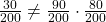 considering 0.15 ≠ 0.eighteen.
Therefore, gender and education hither are not independent.
The second method is to exam if the conditional probability of A given B is equal to the probability of A. Again for simplicity, we can use an already calculated value from to a higher place.
Does P(HS Grad Male) = P(HS Grad)?
 because 0.125 ≠ 0.135.
Therefore, once again gender and education here are non contained.
Affiliate Review
A Venn diagram is a picture show that represents the outcomes of an experiment. It generally consists of a box that represents the sample space Southward or universe of the objects of interest together with circles or ovals. The circles or ovals correspond groups of events called sets. A Venn diagram is especially helpful for visualizing the event, the upshot, and the complement of an upshot and for agreement provisional probabilities. A Venn diagram is peculiarly helpful for visualizing an Intersection of 2 events, a Matrimony of ii events, or a Complement of one event. A arrangement of Venn diagrams can also assist to understand Provisional probabilities. Venn diagrams connect the brain and eyes by matching the literal arithmetic to a film. It is important to note that more than one Venn diagram is needed to solve the probability dominion formulas introduced in Section 3.3.
Use the following data to respond the side by side four exercises.(Figure) shows a random sample of musicians and how they learned to play their instruments.
| Gender | Self-taught | Studied in schoolhouse | Private instruction | Full |
|---|---|---|---|---|
| Female person | 12 | 38 | 22 | 72 |
| Male person | xix | 24 | fifteen | 58 |
| Total | 31 | 62 | 37 | 130 |
Detect P(musician is a female person).
Detect P(musician is a male had private educational activity).
P(musician is a male person had private instruction) =  =
=  = 0.12
Find P(musician is a female is self taught).
Are the events "being a female musician" and "learning music in school" mutually exclusive events?
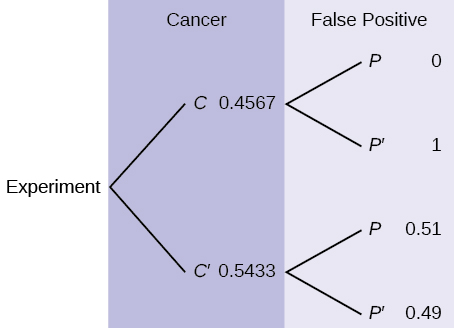
The probability that a human being develops some form of cancer in his lifetime is 0.4567. The probability that a human being has at to the lowest degree one fake positive test result (meaning the exam comes back for cancer when the man does non have it) is 0.51. Let: C = a human develops cancer in his lifetime; P = man has at least one simulated positive. Construct a tree diagram of the state of affairs.
Bringing It Together
Employ the post-obit information to answer the adjacent seven exercises. An article in the New England Journal of Medicine , reported about a study of smokers in California and Hawaii. In one part of the study, the self-reported ethnicity and smoking levels per day were given. Of the people smoking at most ten cigarettes per day, there were 9,886 African Americans, 2,745 Native Hawaiians, 12,831 Latinos, viii,378 Japanese Americans, and 7,650 Whites. Of the people smoking 11 to 20 cigarettes per day, in that location were half-dozen,514 African Americans, three,062 Native Hawaiians, 4,932 Latinos, x,680 Japanese Americans, and 9,877 Whites. Of the people smoking 21 to 30 cigarettes per 24-hour interval, there were 1,671 African Americans, i,419 Native Hawaiians, 1,406 Latinos, iv,715 Japanese Americans, and 6,062 Whites. Of the people smoking at to the lowest degree 31 cigarettes per day, there were 759 African Americans, 788 Native Hawaiians, 800 Latinos, 2,305 Japanese Americans, and iii,970 Whites.
Complete the table using the data provided. Suppose that one person from the study is randomly selected. Observe the probability that person smoked xi to 20 cigarettes per mean solar day.
| Smoking level | African American | Native Hawaiian | Latino | Japanese Americans | White | TOTALS |
|---|---|---|---|---|---|---|
| 1–x | ||||||
| eleven–20 | ||||||
| 21–30 | ||||||
| 31+ | ||||||
| TOTALS |
Suppose that one person from the report is randomly selected. Notice the probability that person smoked 11 to xx cigarettes per twenty-four hours.

Find the probability that the person was Latino.
In words, explain what it means to pick one person from the study who is "Japanese American AND smokes 21 to 30 cigarettes per 24-hour interval." Also, find the probability.
To pick one person from the written report who is Japanese American AND smokes 21 to 30 cigarettes per day means that the person has to meet both criteria: both Japanese American and smokes 21 to xxx cigarettes. The sample space should include anybody in the study. The probability is  .
.
In words, explicate what it means to pick i person from the study who is "Japanese American smokes 21 to 30 cigarettes per mean solar day." Also, find the probability.
In words, explain what it ways to pick one person from the study who is "Japanese American that person smokes 21 to xxx cigarettes per day." Likewise, discover the probability.
To pick one person from the study who is Japanese American given that person smokes 21-thirty cigarettes per twenty-four hour period, means that the person must fulfill both criteria and the sample space is reduced to those who smoke 21-30 cigarettes per day. The probability is  .
.
Prove that smoking level/day and ethnicity are dependent events.
Utilize the post-obit data to answer the next two exercises. Suppose that y'all take eight cards. V are green and iii are yellow. The cards are well shuffled.
Suppose that you randomly draw two cards, ane at a time, with replacement.
Let G 1 = first card is light-green
Allow G two = second card is green
- Draw a tree diagram of the situation.
- Detect P(Grand 1 G two).
- Find P(at least one green).
- Detect P(G 2 G 1).
- Are G 2 and G i independent events? Explicate why or why not.
Suppose that you randomly depict two cards, one at a time, without replacement.
10001 = showtime card is green
G2 = second carte is greenish
- Draw a tree diagram of the situation.
- Observe P(Gone Yardii ).
- Notice P(at least ane green).
- Observe P(One thousandtwo G1 ).
- Are Gii and Gi contained events? Explain why or why not.
Use the post-obit data to answer the adjacent 2 exercises. The percent of licensed U.S. drivers (from a recent year) that are female person is 48.60. Of the females, 5.03% are age 19 and nether; 81.36% are historic period twenty–64; 13.61% are age 65 or over. Of the licensed U.S. male person drivers, 5.04% are age xix and under; 81.43% are historic period 20–64; 13.53% are age 65 or over.
Consummate the post-obit.
- Construct a tabular array or a tree diagram of the situation.
- Notice P(driver is female).
- Discover P(driver is age 65 or over driver is female).
- Find P(driver is age 65 or over female).
- In words, explain the deviation betwixt the probabilities in function c and part d.
- Find P(commuter is age 65 or over).
- Are existence age 65 or over and being female mutually sectional events? How do yous know?
Suppose that 10,000 U.Due south. licensed drivers are randomly selected.
- How many would you wait to be male?
- Using the table or tree diagram, construct a contingency table of gender versus historic period group.
- Using the contingency table, find the probability that out of the age twenty–64 grouping, a randomly selected driver is female.
Approximately 86.5% of Americans commute to work by car, truck, or van. Out of that group, 84.half-dozen% drive solitary and 15.4% bulldoze in a carpool. Approximately 3.nine% walk to work and approximately 5.3% take public transportation.
- Construct a table or a tree diagram of the situation. Include a branch for all other modes of transportation to work.
- Bold that the walkers walk solitary, what percent of all commuters travel lonely to work?
- Suppose that one,000 workers are randomly selected. How many would y'all wait to travel lonely to work?
- Suppose that 1,000 workers are randomly selected. How many would you expect to drive in a carpool?
-
Car, truck or van Walk Public transportation Other Totals Alone 0.7318 Not alone 0.1332 Totals 0.8650 0.0390 0.0530 0.0430 1 - If nosotros assume that all walkers are alone and that none from the other two groups travel lone (which is a big assumption) we have: P(Alone) = 0.7318 + 0.0390 = 0.7708.
- Brand the aforementioned assumptions equally in (b) we take: (0.7708)(1,000) = 771
- (0.1332)(1,000) = 133
When the Euro money was introduced in 2002, two math professors had their statistics students test whether the Belgian one Euro coin was a fair money. They spun the coin rather than tossing information technology and found that out of 250 spins, 140 showed a head (event H) while 110 showed a tail (event T). On that ground, they claimed that it is not a off-white money.
- Based on the given data, detect P(H) and P(T).
- Use a tree to notice the probabilities of each possible consequence for the experiment of tossing the coin twice.
- Use the tree to find the probability of obtaining exactly one head in two tosses of the money.
- Apply the tree to find the probability of obtaining at least i head.
Homework
Use the data in the (Figure) to answer the side by side eight exercises. The table shows the political political party amalgamation of each of 67 members of the U.s.a. Senate in June 2012, and when they are upwards for reelection.
| Upwardly for reelection: | Democratic political party | Republican political party | Other | Total |
|---|---|---|---|---|
| November 2014 | 20 | 13 | 0 | |
| November 2016 | ten | 24 | 0 | |
| Full |
What is the probability that a randomly selected senator has an "Other" amalgamation?
0
What is the probability that a randomly selected senator is upward for reelection in November 2016?
What is the probability that a randomly selected senator is a Democrat and upward for reelection in Nov 2016?

What is the probability that a randomly selected senator is a Republican or is up for reelection in Nov 2014?
Suppose that a fellow member of the US Senate is randomly selected. Given that the randomly selected senator is up for reelection in Nov 2016, what is the probability that this senator is a Democrat?

Suppose that a member of the The states Senate is randomly selected. What is the probability that the senator is upwardly for reelection in Nov 2014, knowing that this senator is a Republican?
The events "Republican" and "Up for reelection in 2016" are ________
- mutually sectional.
- contained.
- both mutually exclusive and contained.
- neither mutually exclusive nor contained.
d
The events "Other" and "Upward for reelection in November 2016" are ________
- mutually exclusive.
- independent.
- both mutually exclusive and independent.
- neither mutually sectional nor independent.
(Effigy) gives the number of suicides estimated in the U.South. for a recent year by age, race (black or white), and sex. We are interested in possible relationships between age, race, and sex. We will let suicide victims be our population.
| Race and sex | 1–xiv | 15–24 | 25–64 | Over 64 | TOTALS |
|---|---|---|---|---|---|
| White, male | 210 | 3,360 | xiii,610 | 22,050 | |
| White, female | lxxx | 580 | 3,380 | 4,930 | |
| Black, male | 10 | 460 | 1,060 | 1,670 | |
| Blackness, female person | 0 | 40 | 270 | 330 | |
| All others | |||||
| TOTALS | 310 | 4,650 | xviii,780 | 29,760 |
Do not include "all others" for parts f and yard.
- Make full in the column for the suicides for individuals over age 64.
- Fill in the row for all other races.
- Find the probability that a randomly selected private was a white male.
- Observe the probability that a randomly selected private was a black female.
- Find the probability that a randomly selected individual was black
- Find the probability that a randomly selected individual was male.
- Out of the individuals over age 64, find the probability that a randomly selected private was a black or white male.
-
Race and sexual practice i–14 xv–24 25–64 Over 64 TOTALS White, male 210 three,360 13,610 iv,870 22,050 White, female 80 580 3,380 890 4,930 Black, male 10 460 1,060 140 1,670 Blackness, female person 0 forty 270 20 330 All others 100 TOTALS 310 four,650 18,780 6,020 29,760 -
Race and sex 1–xiv 15–24 25–64 Over 64 TOTALS White, male 210 3,360 13,610 4,870 22,050 White, female lxxx 580 3,380 890 four,930 Blackness, male 10 460 1,060 140 ane,670 Blackness, female 0 40 270 twenty 330 All others x 210 460 100 780 TOTALS 310 four,650 eighteen,780 half dozen,020 29,760 -

-

-

-

-

Use the post-obit information to respond the next 2 exercises. The table of information obtained from www.baseball-almanac.com shows hit data for 4 well known baseball players. Suppose that 1 hit from the table is randomly selected.
| Proper name | Single | Double | Triple | Dwelling run | Total HITS |
|---|---|---|---|---|---|
| Baby Ruth | 1,517 | 506 | 136 | 714 | 2,873 |
| Jackie Robinson | 1,054 | 273 | 54 | 137 | 1,518 |
| Ty Cobb | iii,603 | 174 | 295 | 114 | four,189 |
| Hank Aaron | ii,294 | 624 | 98 | 755 | 3,771 |
| Full | 8,471 | 1,577 | 583 | 1,720 | 12,351 |
(Effigy) identifies a group of children past one of iv hair colors, and past type of pilus.
| Hair type | Brown | Blond | Black | Ruby-red | Totals |
|---|---|---|---|---|---|
| Wavy | 20 | 15 | 3 | 43 | |
| Direct | fourscore | 15 | 12 | ||
| Totals | 20 | 215 |
- Complete the table.
- What is the probability that a randomly selected child will have wavy hair?
- What is the probability that a randomly selected child will have either brown or blond hair?
- What is the probability that a randomly selected kid will have wavy brown pilus?
- What is the probability that a randomly selected kid will have red hair, given that he or she has straight hair?
- If B is the event of a child having brown pilus, find the probability of the complement of B.
- In words, what does the complement of B represent?
In a previous twelvemonth, the weights of the members of the San Francisco 49ers and the Dallas Cowboys were published in the San Jose Mercury News . The factual data were compiled into the following table.
| Shirt # | ≤ 210 | 211–250 | 251–290 | > 290 |
|---|---|---|---|---|
| 1–33 | 21 | 5 | 0 | 0 |
| 34–66 | 6 | eighteen | vii | 4 |
| 66–99 | 6 | 12 | 22 | 5 |
For the post-obit, suppose that you randomly select one histrion from the 49ers or Cowboys.
- Notice the probability that his shirt number is from 1 to 33.
- Detect the probability that he weighs at most 210 pounds.
- Find the probability that his shirt number is from 1 to 33 AND he weighs at almost 210 pounds.
- Find the probability that his shirt number is from 1 to 33 OR he weighs at near 210 pounds.
- Find the probability that his shirt number is from ane to 33 GIVEN that he weighs at well-nigh 210 pounds.
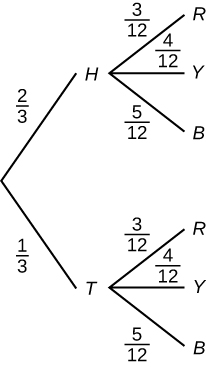
Use the following data to reply the adjacent two exercises. This tree diagram shows the tossing of an unfair coin followed by drawing one bead from a cup containing three red (R), four yellow (Y) and five blue (B) chaplet. For the coin, P(H) =  and P(T) =
  where H is heads and T is tails.
A box of cookies contains three chocolate and seven butter cookies. Miguel randomly selects a cookie and eats it. Then he randomly selects some other cookie and eats it. (How many cookies did he take?)
- Draw the tree that represents the possibilities for the cookie selections. Write the probabilities forth each branch of the tree.
- Are the probabilities for the flavor of the 2nd cookie that Miguel selects contained of his offset selection? Explicate.
- For each consummate path through the tree, write the upshot information technology represents and observe the probabilities.
- Let S exist the event that both cookies selected were the aforementioned season. Notice P(S).
- Let T be the effect that the cookies selected were different flavors. Find P(T) by two different methods: by using the complement rule and by using the branches of the tree. Your answers should exist the same with both methods.
- Let U exist the outcome that the second cookie selected is a butter cookie. Find P(U).
Cardinal Terms
- Venn Diagram
- the visual representation of a sample space and events in the form of circles or ovals showing their intersections
5 Draw a Vinn Diagram to Illustrate This Conditional
Source: https://opentextbc.ca/introbusinessstatopenstax/chapter/venn-diagrams/

Post a Comment for "5 Draw a Vinn Diagram to Illustrate This Conditional"